
What if hospitality spaces told better stories?
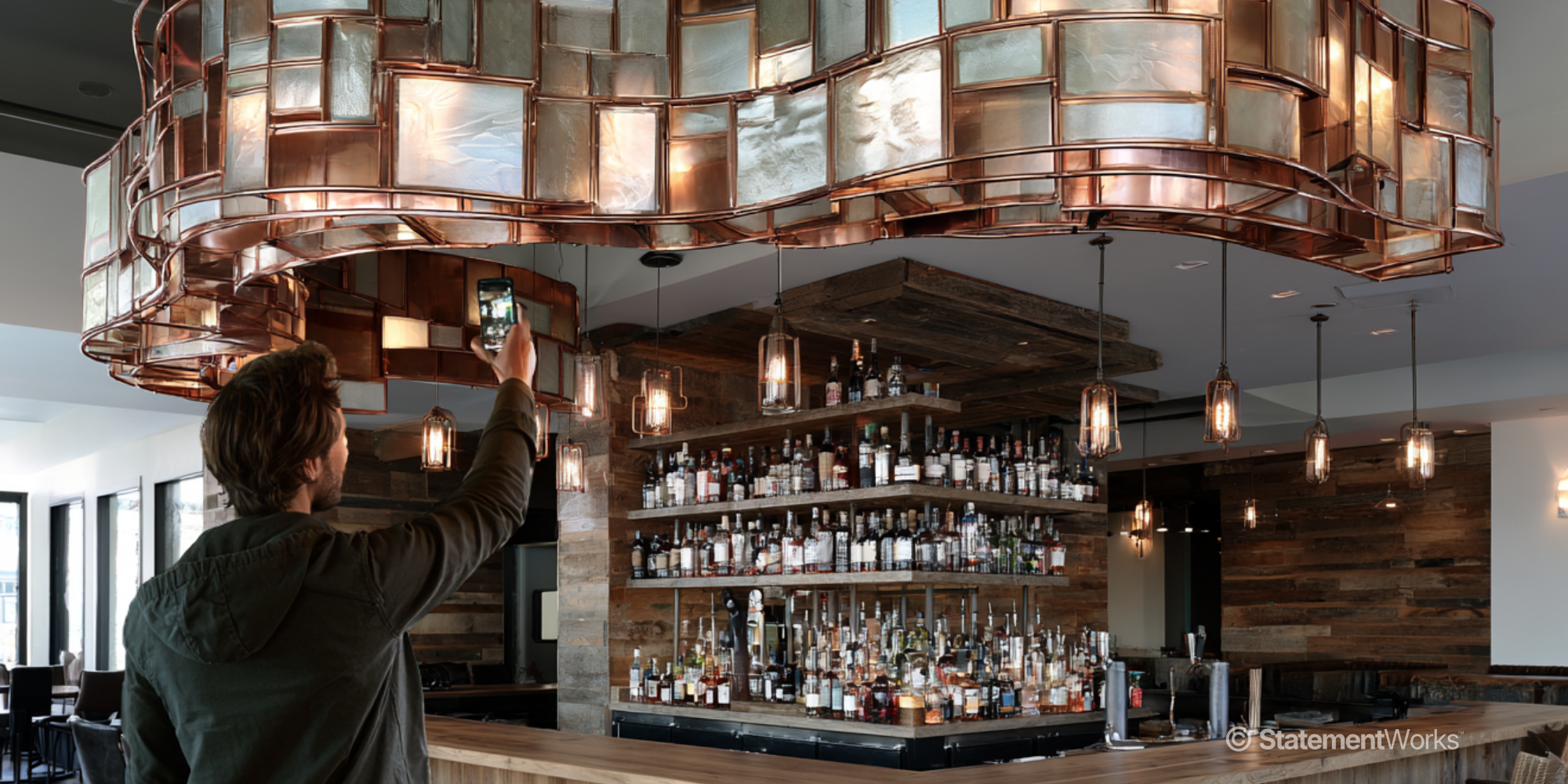
Interactive sculptural bar header
An imperative to differentiate and make deeper customer connections.
Picture a well-loved pub in a touristy hotspot. The beer is exceptional. The provenance story, the brewery heritage, the deep roots in the locality, is genuinely compelling, differentiated, and underused in the physical spaces the brand occupies. A guest sits at the bar and everything around them is pleasant, clean, and well-maintained. The brand is present in the obvious places, but the space itself is not telling that story.
Now picture a different version of that same pub. Above the bar, a beautifully designed and crafted piece that personifies the heritage and meaning of the brand, something that makes a guest look up with intrigue and wonder, perhaps something they can interact with on different levels. The landlord's answer takes ten or so seconds and creates a connection that no social media post or brand guidelines document has ever managed.
The guest photographs it. They share it. They talk about it. They come back.
That is the question this article is asking. Not whether regional brewers, managed pub groups, hotels or restaurants are doing this, because in the main they are not, at least not yet, and not in any systematic way. The question is what it would mean commercially if they did, and why the conditions for doing it have arguably never been better.
The gap that exists
British pub, restaurant and hospitality brands are, in many cases, sitting on extraordinary raw material. The regional brewers, managed pub estates, restaurants and country hotel groups operating across the South East and East of England have incredible histories, stories, and genuine identities that most consumer brands would pay significantly to possess.
What they often don’t yet have, is a way of making those identities felt as a physical experience inside the venues themselves. The brand exists in the marketing, in the packaging, in the digital presence. The physical space, the thing a guest actually inhabits for a few hours, is often where that story goes quiet.
This is not a criticism of how these venues look. Many of them look very good. It is an observation about the difference between a space that has been designed and a space that has been given something to say.
What a physical brand statement actually is
It is worth being precise here, because the phrase risks sounding grander or more complicated than it needs to be.
A physical brand statement is not signage. It is not branded upholstery, a vinyl mission statement nor an illuminated acrylic sign on a wall. It is not interior design in the conventional sense, though it works in close relationship with it.
It is a bespoke, considered object or installation that makes a brand genuinely felt in the space it occupies. Something that stops a guest, earns their attention for a moment, and creates a connection between them, the place, and the brand behind it. It can be sculptural, interactive, kinetic, or quietly beautiful. What it cannot be is generic, because the moment it is generic it has already failed at the only thing it exists to do.
These things don’t need to be on a monumental scale or overly complex. A single beautifully conceived and well-placed piece in the right space within a pub or hotel can work hard to engage customers. The principle is to make the space say something true about the brand, and make it say it in a way that earns attention and creates a moment of genuine connection.
Why the commercial logic is compelling right now
Two things are happening simultaneously that make this a particularly timely conversation.
The first is the social sharing economy. Every interesting physical space in a hospitality venue is now a potential marketing asset operating continuously and at scale. When a guest photographs something and shares it, they are producing earned media of a quality and authenticity that paid advertising cannot replicate. Research by AnyRoad (2025) found that 85% of consumers report increased purchase intent following a meaningful in-person brand interaction. Salmon Labs data from early 2026 indicates that 72% of visitors to distinctive physical brand environments share their experience online. A well-placed installation generates this every day the venue is open, without a media budget attached.
The second is the cultural moment. There is a genuine and growing fatigue with digital-first everything. Guests are actively seeking out experiences that feel real, tactile, and considered. The physical space has become a statement of authenticity in a way it has not been for some time. Venues that give people something genuinely interesting to look at and engage with are tapping into a behaviour that is, if anything, strengthening.
The multi-site opportunity is the real prize
A single venue can benefit from a physical brand statement, and benefit meaningfully. But the more interesting conversation is with operators running multiple sites.
A pub group with twenty venues across the home counties, or a hotel brand with properties from Cambridge to the Kent coast, has an opportunity that a single-site operator does not. They can develop a physical brand language: not a rollout of identical pieces, but a consistent commissioning approach that creates something distinctive and identifiable at each venue while building a cumulative body of work across the estate.
This matters for several reasons. Guests who visit more than one site in a group develop a frame of reference. They arrive at an unfamiliar venue with an expectation, shaped by experience elsewhere in the portfolio, that the space will have something worth noticing. That expectation is itself a loyalty mechanism, operating independently of any formal rewards programme.
It also matters for the brand's social footprint. Each distinctive piece at each venue is its own point of content generation. The cumulative effect across a managed estate is a body of earned media that reinforces the brand's identity and reach in ways that a centralised marketing campaign cannot easily replicate.
For operators in the South East and East of England, the geography of this opportunity is particularly strong. The region contains some of the UK's most commercially significant and story-rich hospitality assets: the coastal pub estates of Suffolk, Norfolk, and Kent; the country house hotel market across the home counties; the competitive premium dining and drinking market along the Thames corridor and into Cambridge and Norwich. These are venues serving audiences who are discerning, digitally active, and highly likely to share a genuinely interesting physical experience when they encounter one.
The spaces that are doing nothing
It is worth thinking specifically about where within a pub or hotel this kind of investment earns its place most directly.
The arrival sequence is the most consistently underdeveloped. In most venues it is treated as transition, a space the guest moves through on the way to somewhere more important. Yet it is where the first impression forms and the emotional register of the whole visit is set. A physical statement at the entrance does not need to be large. It needs to be intentional, and it needs to signal immediately that what follows has been thought about.
The bar environment is where guests spend unstructured time. They are waiting, looking around, not yet committed to a conversation or a task. They are, in that moment, the most receptive audience in the building, and in most venues the space is doing nothing at all to earn their engagement.
The in-between spaces are perhaps the most overlooked. The corridor to the function suite, the landing between floors, the covered outdoor area that gets used on awkward weather days. These are the spaces venues cannot quite decide what to do with, and a well-placed interactive or sculptural piece can transform them from dead zones into moments of connection that guests remember and talk about.
The practical question
The honest barrier for most operators, when this kind of conversation gets beyond the initial enthusiasm, is the complexity of making it actually happen. Who conceives it? Who manages the production? Who handles the structural considerations in a listed building, the risk assessment, the installation, and the maintenance when something needs attention a year later?
These are fair questions, and the answer should always be that the same people who conceive it are responsible for all of it, end to end, from the initial brief through to aftercare. An operator's job is to be clear about what they want the space to do for their brand and their guests. The process of getting from there to a finished, installed, maintained piece is a managed service, not a series of separate commissions handed off to separate contractors.
This matters especially for multi-site operators, where the ability to run a consistent commissioning and delivery process across a portfolio, at different venues with different physical constraints and different brand moments to create, is as valuable as the quality of any single piece.
The honest starting point
There is no template for this, and the absence of a template is precisely the point.
The best physical brand statements in hospitality begin with an honest conversation about what a venue actually is: what its history carries, what its guests are genuinely looking for, what the brand believes about itself beyond the marketing language. A coastal brewery pub, a Home Counties gastropub group, and a boutique hotel collection each have a completely different story to tell. The work of making that story physical begins with understanding what it actually is.
That conversation is available to any operator willing to have it. The venues that have it first are the ones that will own the physical identity of their catchment, and the social footprint that comes with it, for as long as they choose to.
The space is already there. The question is simply what it could be saying.